APNM
APNM   Web
Animal Protection of New Mexico

Untitled Document

APNM Home
Core Programs

Trapping
Fact Sheet
Press Release
NM Trapping Charts
Reporting Form
Media on Trapping


trapping

(Note: this page contains graphic images.)

[section in update]

(Note: this page contains graphic images.)

A 2005 survey of New Mexicans reveals that, across the board, a strong majority (63%) is against trapping on our public lands. Regardless of gender, ethnicity, political leanings, or recreational hobbies, New Mexicans support ending the cruel and indiscriminate practice of trapping on New Mexico's public lands.

The survey also showed that most New Mexicans were not aware that trapping is legal on public lands. This page is an effort to raise awareness about trapping and to encourage New Mexico wildlife law to reflect New Mexicans' opinions.

New Mexico trapping factpage (PDF)
Read the November 14th press release about the survey


If you have ever had an encounter with a trap on New Mexico public lands, please share your experience with us here! We are compiling information about trapping encounters to learn more about the scope of the problem. Click for trapping reporting form.

If you would like to be kept up-to-date on trapping in New Mexico, please send your contact information to APNM's Wildlife Manager.


Questions & Answers about Trapping in New Mexico:

What can I do about trapping in New Mexico?
What is trapping?
What are the rules?
What animals are trapped?
What are the problems with trapping?
What are the Latest New Mexico Wildlife Trapping Statistics?
The Economics of New Mexico Trapping and Wildlife
The Trapping Myths
Recent Newspaper Articles


What can I do about trapping in New Mexico?

  1. Email APNM's Wildlife Campaigns Manager, if you have a concern or question. Provide your name, address, preferred email, and telephone. Also, let APNM know if you have ever encountered a trap on public lands and what your experience was. APNM is building a network of concerned citizens about trapping, and will update you as progress is made.

  2. Contact your local state representative. Respectfully let them know you are opposed to trapping on public lands. Letters are better than emails. To find out who your state representatives are, please check at this website: legis.state.nm.us/lcs/legislatorsearch.asp

  3. Contact New Mexico's Game Commission and Director. Respectfully let them know you opposed trapping on public lands. Letters are better than emails. Their contact information can be found at: wildlife.state.nm.us/commission/index.htm

  4. Contact New Mexico Governor Bill Richardson. Respectfully let him know you oppose trapping on public lands. Again letters are better than emails. Here is his contact information:

    Governor Bill Richardson
    490 Old Santa Fe Trail
    Room 400
    Santa Fe, NM 87501

    Website

  5. Send a letter to the editor of your local New Mexico paper. Most newspapers around the state have a way to submit a letter to the editor via email. Check out their websites and look for "Contact Us," or "Letters to the Editor."


What is trapping?

Trapping is used to capture and kill animals. Most often, people trap wildlife in order to sell their furs, although some people do it to "control" wildlife, and others trap as a hobby.

All traps snap shut in response to pressure on the trigger mechanism. They are unable to distinguish among wildlife, companion animals, or people.

There are three types of traps currently legal in New Mexico: steel leg-hold, steel Conibear, and wire snares.
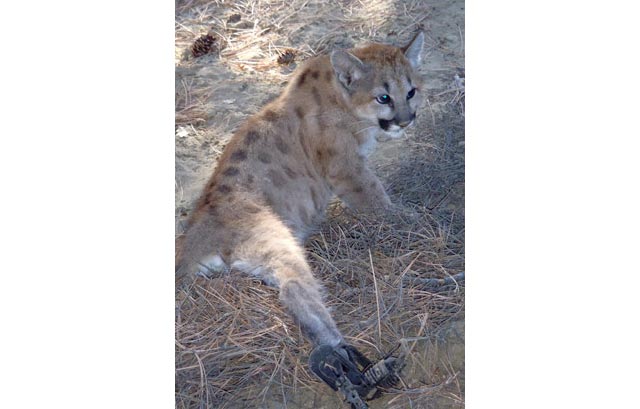
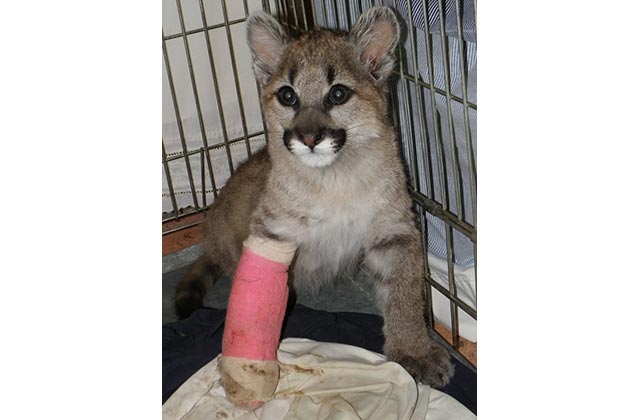
Steel leg-hold traps come in two forms: coil-spring and long-spring. Both of these traps are "sprung" by a pan trigger in the middle of the trap. Pressure on the pan releases the jaws of the trap to shut on whatever part of the body is exposed. The traps are extremely strong, occasionally breaking limbs and often cutting off circulation to the part of the body caught in the trap so that it is permanently damaged.

Conibear traps are shaped in a small square. These traps are triggered by wires within the middle of the trap. Conibears are designed to crush the heads of wildlife, supposedly killing the animal quickly. Yet very often, these traps fail to kill the animal immediately because the trap closes on the mid-section or does not close with enough pressure. For example, domestic dogs have had their snouts broken and held until they have starved to death. Conibears often are used in water so that wildlife is held until drowning.

Snares are made of metal wire or plastic. Snares are placed in a loop so that after an animal places a part of the body in the loop, the snare tightens on the animal as he/she struggles. Very often limbs are damaged due to the struggles of the animal, and either permanent damage is done to the animal due to a loss of circulation, or the animal chews off his/her limb to escape.

What are the rules?

In New Mexico traps, may be encountered year-round. There are no bag limits, trap limits, or game units restrictions.
Trapping is allowed anywhere on public lands (state, National Forest, or BLM lands) outside 25 yards of a hiking trail designated by the agency on a map provided for the general public; 25 yards of the shoulder of any public road annually maintained with public funds; 50 yards of a livestock/wildlife watering area; or one-quarter mile of a dwelling, public campground, or rest-, picnic-, or boat-launching area (exceptions: no trapping Los Alamos county, Rio Grande recreation area in Taos County, Valle Vidal, McGregor military range unit 28, or Valles Caldera unit 6).
State law requires that traps be checked every 24 hours by the trapper or a representative of the trapper. Traps must be marked either with the trapper's name and address, or a trapper ID number (provided free by New Mexico Department of Game and Fish [NMDGF]). The location of traps is not shared with Game & Fish wardens, nor do trappers post warning signs on public lands so that people can protect their children and companion animals.
Coyotes and skunks may be trapped year-round without a license. Trapping other wildlife requires a $20 license from NMDGF, with half-year seasons in the fall, winter, and spring.

What animals are trapped?

In New Mexico, there are legal trapping seasons for badgers, beavers, bobcats, coyotes, fox, muskrats, nutrias, raccoons, ringtails, squirrels, and weasels. Coyotes and skunks can be trapped year round.
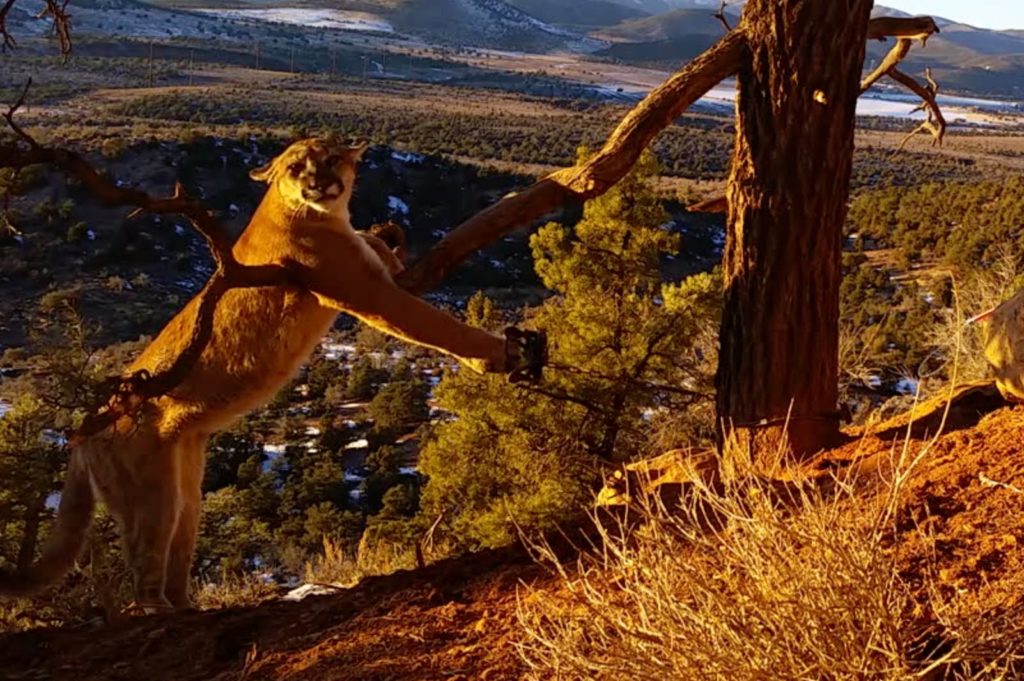
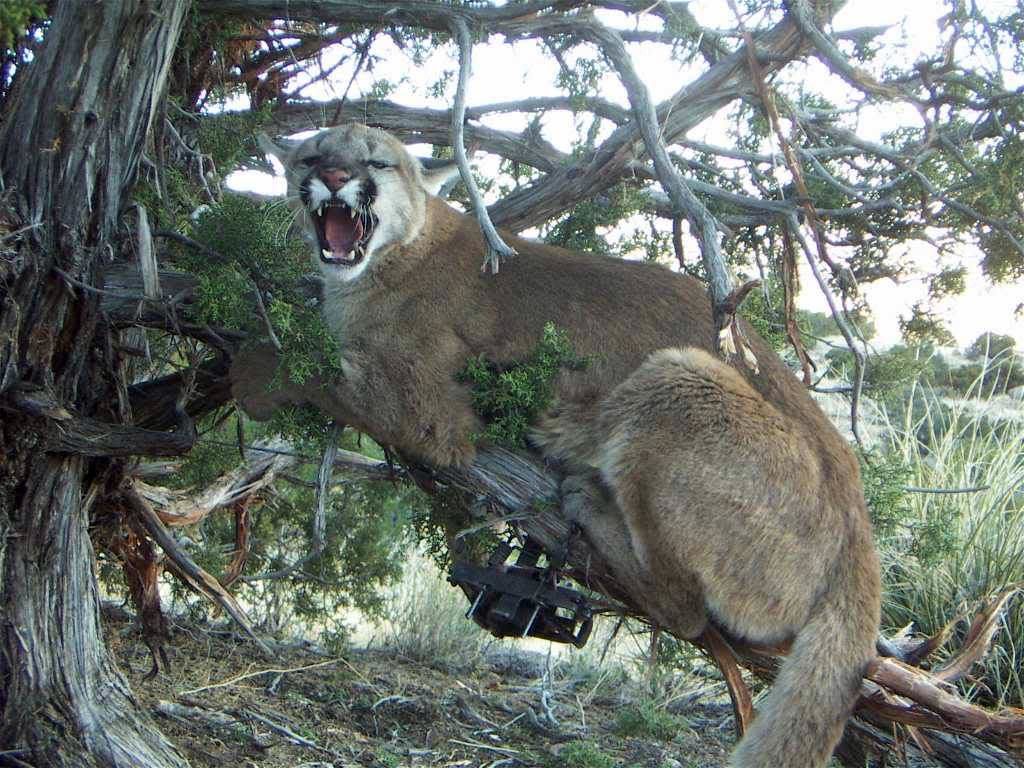
There are no legal trapping seasons for birds, black bears, cats (domestic), coatimundis, deer, dogs (domestic), javelinas, mountain lions, pine martens, wolves, or threatened or endangered species, but they are often trapped as "by-catch." Trappers are not penalized or fined for killing by-catch animals.

What are the problems with trapping?

There are many very serious problems with trapping in New Mexico today, but the primary problem with trapping is that it is cruel. Animals may suffer for hours, days, or weeks with a limb curshed between pieces of metal. Even in a best-case scenario, in which a trapper discovers an animal within 24 hours, the animal will have suffered for hours, and his/her end will come by either being clubbed to death or strangled (trappers prefer not to shoot trapped animals because the bullet hole will reduce the value of the pelt).

Another big problem with trapping, regardless where it occurs, is that it is indiscriminate. Traps do not think and cannot distinguish between a target animal, a mule deer, a companion animal dog, or a child. Given the multitude of other wildlife on public lands, the chance that a trapper will only trap his target species is not very great.

Besides moral concerns about trapping being cruel and indiscriminate, there are also safety and wildlife management concerns with trapping. Current trapping regulations in New Mexico allow the following scenario:
1. A trapper purchases a license for $20
2. The trapper is allowed to place as many traps as he wants on public lands- 10, 50, 200- there is no trap limit.
3. The trapper is not required to post any warning signs, or even alert the local game warden to the presence of his traps.
4. The trapper is allowed to kill as many animals as he can catch- 10, 50, 200- there are no bag limits or quotas.
The situation is made even more disturbing by the fact that New Mexico Game & Fish is not monitoring the populations of trapped wildlife. We have no idea what trapping is doing to New Mexico's wildlife populations.

What are the latest New Mexico wildlife trapping statistics?
(update in progress)

According to New Mexico Department of Game & Fish, X trappers reported X animals killed last season. Game & Fish, however, estimates that there are actually X trappers in New Mexico, suggesting that more than X animals were killed in New Mexico last season (2007-2008) by traps. Yet this number still does not include coyotes or skunks, because Game & Fish does not require a trapping license or reporting to trap these two species. So the total number of animals killed by trappers in New Mexico is actually much higher.

For a breakdown of species, click these links for New Mexico Department of Game & Fish's trapping statistics from the last few seasons: wildlife.state.nm.us/recreation/hunting/harvest/06-07furbearerharvestforweb.pdf

Go to this link for all other NMDGF hunting and trapping information:
http://www.wildlife.state.nm.us/recreation/hunting/index.htm

The Economics of New Mexico Trapping and Wildlife
(update in progress)
Trapping
* X estimated trappers in New Mexico (95% in-state)
* More than X animals trapped (by-catch unknown)
* $X generated by trapping (licenses, equipment, pelt sales)
VS.
Wildlife-Watching
* 387,000 tourists visit New Mexico to wildlife-watch
* 449,000 New Mexicans wildlife-watch
* $931,500,000 generated by wildlife-watching in New Mexico
Sources: New Mexico Department of Game & Fish and the U.S. Fish and Wildlife Service.

The Trapping Myths

There are three primary arguments made for trapping on public land:
* "Trapping helps control predators"
While this excuse is often cited by many in the agricultural field, the truth is that trapping accomplishes very little in reducing livestock losses to wildlife.

First, some context: losses of livestock to wildlife in New Mexico are very low. According to a 2004 survey of New Mexico's sheep and lamb growers,* just 4% of their livestock was lost to wildlife. Meanwhile, 8% was lost to non-wildlife causes, such as digestive problems and old age. In fact, more sheep died in New Mexico in 2004 from rolling on their backs and not being able to get back up (200) than were killed by black bears (100).

Furthermore, there has been no increase in the number of livestock lost to wildlife in states that have prohibited trapping on public lands. For example, in 1996 the state of Colorado placed restrictions on trapping on public lands, yet between 1994 and 2004 the total number of sheep and lambs lost to wildlife actually dropped by 62%!

Clearly, restricting trapping on public lands in Colorado has not resulted in more livestock lost to wildlife.

* Source: National Agricultural Statistics Service, USDA

* "If you prohibit trapping on public lands, hunting will be next" -This is a favorite scare tactic used by trappers to enlist hunters to their cause because there are so few trappers to justify the practice (fewer than 800 licensed in New Mexico in 2004).

In fact, according to a 2005 survey of New Mexicans by Research & Polling, Inc., a trusted New Mexico polling firm, 52% of hunters favor prohibiting trapping on public lands, while only 33% oppose it (the remainder are noncommittal).
* "Trapping is a traditional way of life"
This argument is often made as a last resort, when other excuses have been proven false.

It is true that trapping has been practiced in New Mexico for hundreds of years. Yet we live in a different world than we did 200 years ago, when there seemed to be no limit to our state's unique wildlife.

Our public lands have different priorities now, with many more people wanting to enjoy public lands and wildlife for recreational purposes. In fact, wildlife-watching is so popular that it is estimated to bring in more than $932 million dollars to New Mexico.*

Wildlife in New Mexico have a right to live free in the wild without the threat of being trapped and suffering in pain for hours or days between two pieces of crushing steel. Also, people finally deserve to be able to enjoy our public lands without fear of harm from traps to themselves, their children, or companion animals.

*Source: U.S. Fish and Wildlife Service, 2001, National and State Economic Impacts of Wildlife-Watching

Have you ever encountered a trap in New Mexico? Help us change trapping regulations in New Mexico by submitting your experience! Click for trapping reporting form.

Media
Silver City Sun-News: "Traps Set Off Fuss"

Albuquerque Journal: "Animal Trapping Denounced"
Friday, November 18, 2005

By Tania Soussan
Journal Staff Writer
Recent cases of unlicensed steel foothold traps snapping on a hiker's dog in the Gila and a coyote in Eldorado that dragged the trap around for weeks highlight problems with trapping in New Mexico, activists say.
"There are no bag limits, no limits to the number of traps set out and very little oversight of cruel and indiscriminate trapping in New Mexico," Winston resident Mary Katherine Ray, a volunteer for the Rio Grande chapter of the Sierra Club, said this week.
The group has campaigned to ban trapping on public lands across the state.
Jon Schwedler of Animal Protection of New Mexico said state numbers show more than 18,000 animals were killed by traps in New Mexico last year.
The New Mexico Trappers Association does not condone unlicensed trapping and educates trappers on ethical and legal practices, said the association's president, Ernie Ray Current.
Done correctly, trapping is humane, he said.
The state requires traps be checked every 24 hours and non-target species be released. The fall trapping season for most animals started Oct. 15.
In the Eldorado coyote case, the animal carried a trap on a leg for several weeks before being caught by Santa Fe Animal Control and eventually euthanized.
Earlier this month, a woman walking in the Gila National Forest reported her dog's leg was clamped in trap. When the woman tried to free the dog, she stepped into a second trap that grazed her toes, drawing blood and then clamping onto the end of her sandal.
Current said his dog has been trapped as well.
"It's not hurting the dog," he said. "That's a myth if your trap's set up right."
In another case in October, an endangered Mexican gray wolf in southern New Mexico was found running with a trap on her right front paw. By the time she was caught, her paw was so badly damaged that the toes and pad had to be amputated.
Although the U.S. Fish and Wildlife Service uses traps to catch wolves, that trap was not set by the project team.

All trapping photos: Humane Society of the United States


All trapping photos: Humane Society of the United States

Home :: About APNM :: Core Programs :: Get Involved
Animal Protection of New Mexico, Inc. (APNM)

P.O. Box 11395, Albuquerque, NM 87192
(505) 265-2322 | (505) 265-2488 (fax) | email apnm
© APNM, Inc. | Notify problems with site to: webmaster